Docs and this page
Docs / GEO
GEO guide
Read what the world published around a session, from public records, each against its own normal.
Free to read, no account. Geo alerts, the API and Team are Geo's own plans: Geo plans. The GEO product page · Markdown copy
Why it matters
A move on the tape often has a story told somewhere else first: a travel notice, a maritime warning, an airport ground stop, a tornado warning. Those records are public, but scattered over many sites and formats.
Geo answers one question: what was published around this minute, and was any of it unusual? It reads public sources by sector, keeps each record's own publication time and its link, and marks a record notable when it stands out against that source's normal for the country.
It is context. Nothing in Geo is a forecast, a cause or a trade, and it does not beat the news.
Where to find it
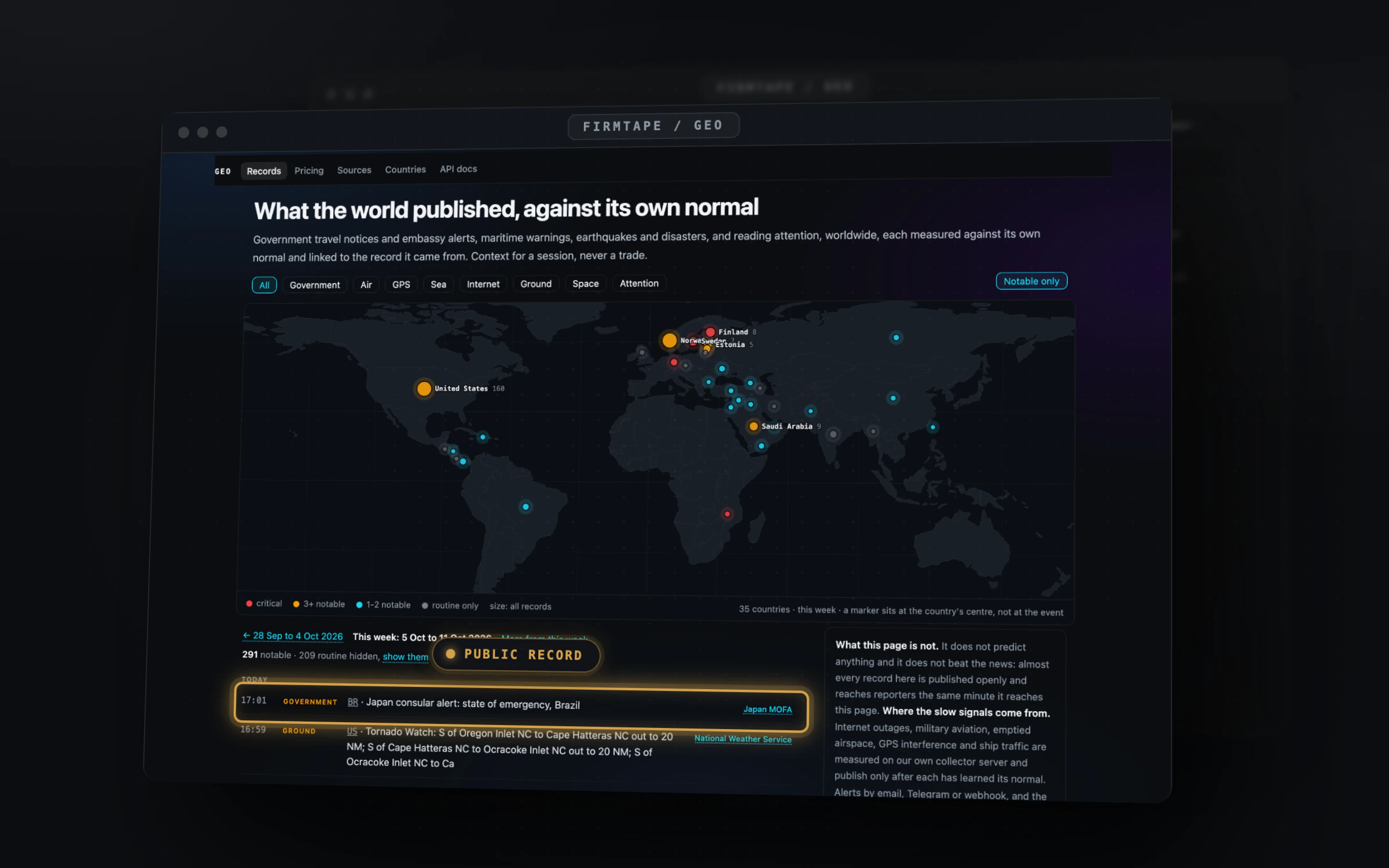
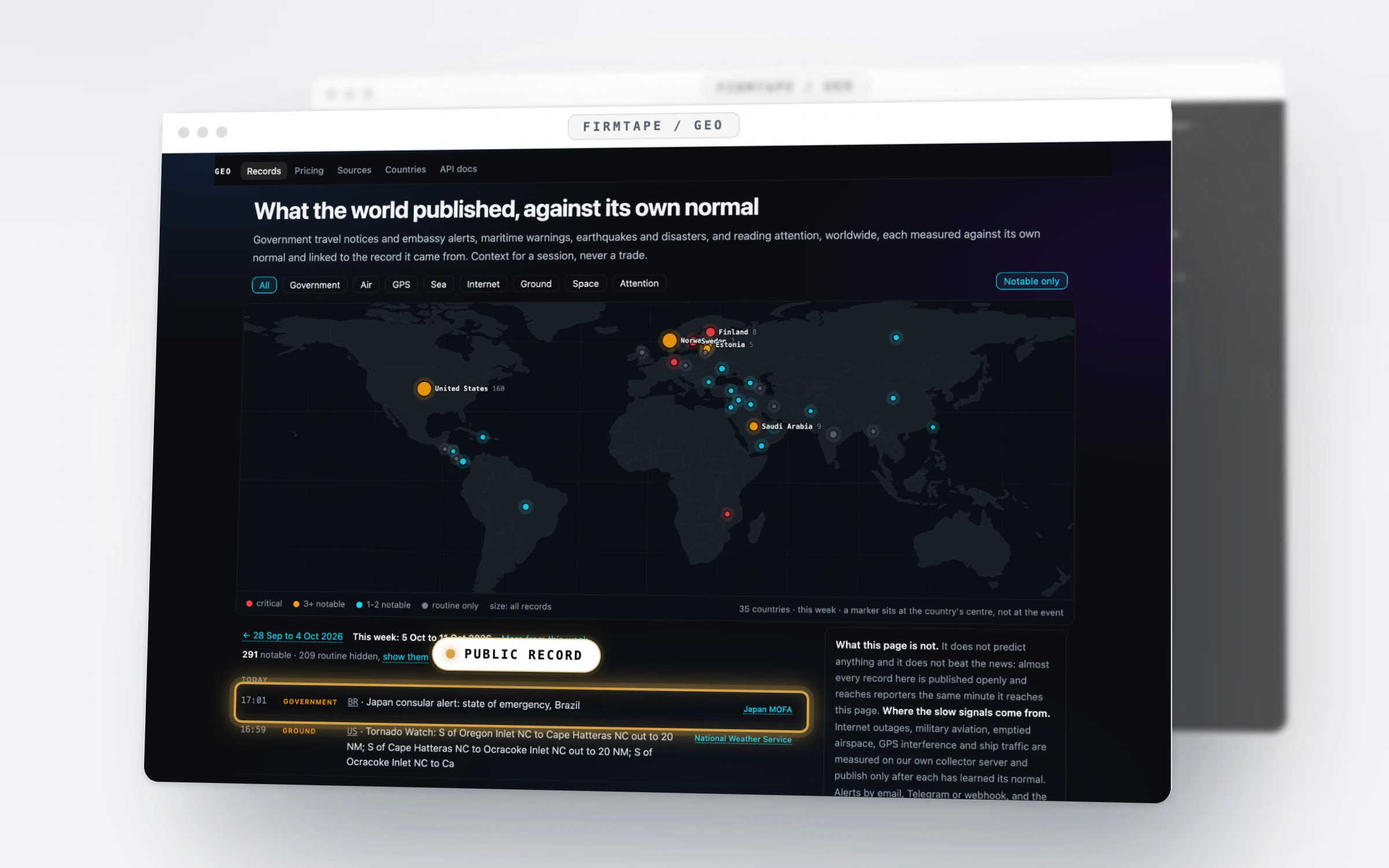
The list opens beside the chart from the globe on the toolbar. The full pages are at /geo: the map and the feed, one page a sector and a country, every past week, and the sources.
| You want | Go to |
|---|---|
| What was published in the last day, beside the chart | The globe on the toolbar (or W) |
| The world map and the week's records | /geo |
| One sector or one country | The sector chips on /geo, or /geo/countries |
| Which sources answered | /geo/sources |
| Alerts on the records you care about | Account, Geo alerts, on a Geo plan |
Read it in 30 seconds
- Notable only is the default: the rows you see are the ones that stood out against their own normal.
- The time on a row is the time in ET, next to the session's own clock.
- The sector label (SEA, AIR, GROUND, GPS) says what kind of record it is.
- On the map, a bigger marker is more records this week; colour is how many were notable, red the critical ones.
- The source count at the top says how many sources are fresh; a quiet list with every source fresh is a quiet day, not a gap.
How to use it
Look it up
The GEO list beside the chart#
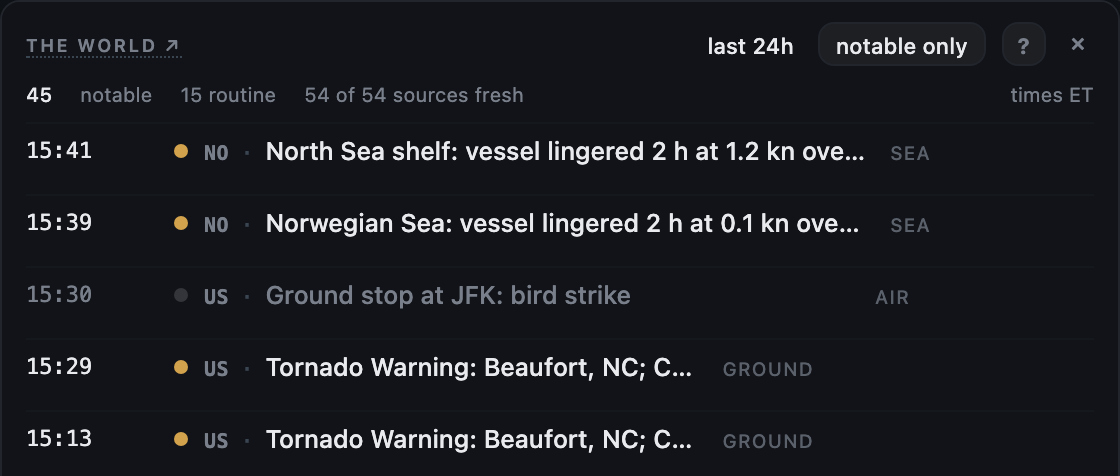
Why: what was published in the last day, next to the chart and on its clock, without leaving the terminal. Where: the globe on the toolbar, or W. Plan: Free to read.
- Press the globe on the toolbar, or W.
- Read the last 24 hours: time ET, country, the record, its sector, and a link to its source.
- Keep notable only on, or switch it off for every row.
- Alert settings at the foot of the list opens the Geo alerts pane.
How to read it:
- The header counts notable and routine records and how many sources are fresh.
- A dimmed row is routine; a dot marks a notable one.
- A record is context for the session. It does not say what the market will do.
Limits: The list holds the last 24 hours; older records are on the week pages at /geo.
Related: GEO: The map and the feed · GEO: Notable only · REPLAY: Market calendar and pulse
The map and the feed#
Why: the week's public records on one map and one list, each linked to the record it came from. Where: /geo. Plan: Free to read, no account.
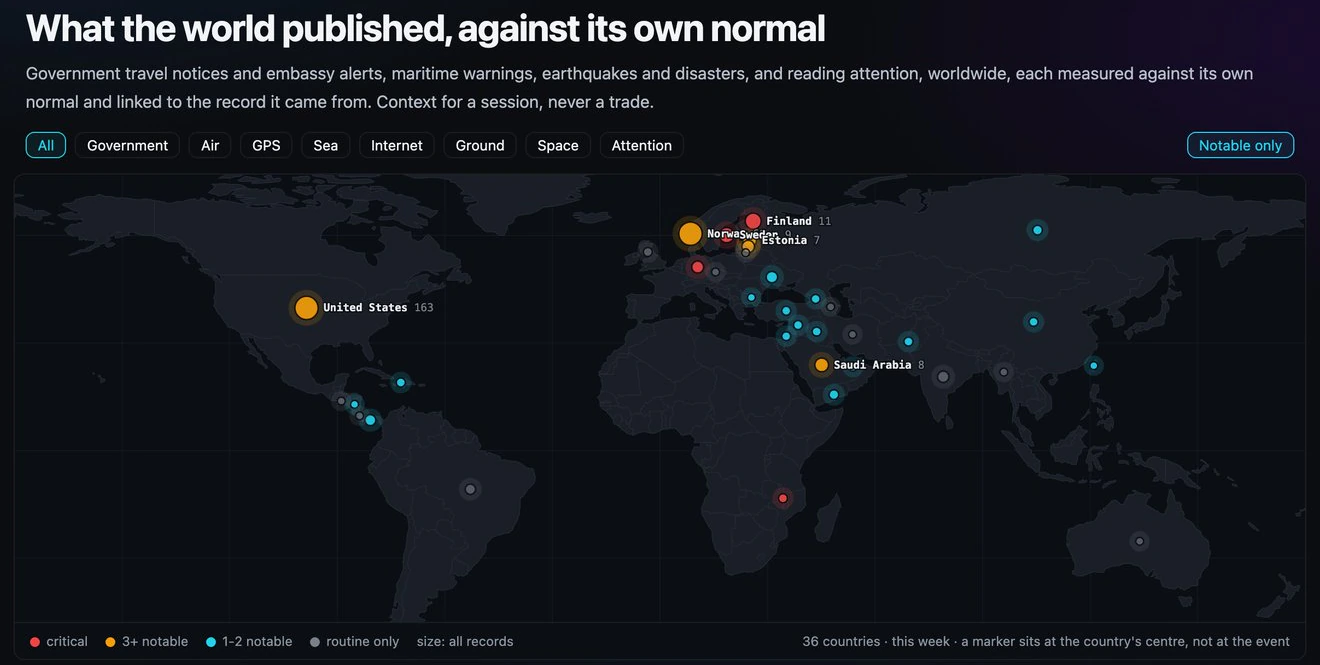
- Open /geo: the map is this week, the feed under it is newest first.
- Read the legend: red critical, amber three or more notable, cyan one or two, grey routine only; size is all records.
- Click a country for its own page.
How to read it:
- A marker sits at the country's centre, not at the event.
- The count beside a country is its records this week.
Limits: One week a page, so no page pulls the whole history at once.
Related: GEO: Sectors and countries · GEO: Weeks
Sectors and countries#
Why: follow only the records that matter to you: a sector across the world, or every sector in one country. Where: the chips on /geo; /geo/countries for every country. Plan: Free to read, no account.
- Pick a chip: Government, Air, GPS, Sea, Internet, Ground or Attention.
- Open a country from the map or from /geo/countries.
- Each sector and country page has its own weeks, like the world page.
| Control | What it does |
|---|---|
| Government | Travel notices and embassy alerts |
| Air | Airspace and airport status |
| GPS | GPS interference |
| Sea | Maritime warnings and ship traffic |
| Internet | Internet outages |
| Ground | Weather warnings, earthquakes and disasters |
| Attention | Reading attention to a place, against its normal |
Limits: A country page lists only the countries seen in the served history.
Related: GEO: The map and the feed · GEO: Notable only
Notable only#
Why: one unusual record should not drown in a hundred routine ones. Where: notable only in the GEO list; Notable only on every /geo page. Plan: Free to read.
- Leave notable only on, the default.
- Switch it off to see every row, routine ones dimmed.
What it measures: A record is notable when it stands out against its own source's normal for that country. Sources that need a normal learn it first and publish only after.
How to read it:
- A quiet list with every source fresh is a quiet day, not a gap.
Limits: Notable is a measure against the source's own history, not a judgement of importance.
Related: GEO: The GEO list beside the chart · GEO: Sources
Weeks#
Why: a finished session can be read next to what was published that week. Where: the week line under the map; the Last 30 days tiles on /geo. Plan: Free to read, no account.
- Use the arrow on the week line for the previous week.
- Or pick a tile under Last 30 days: each shows its records and how many were notable.
- Every week, world and per sector, keeps its own address.
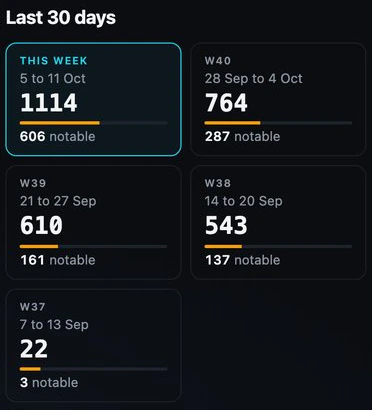
How to read it:
- The bar under a count is the share that was notable.
Limits: Weeks run Monday to Monday on the New York calendar.
Related: GEO: The map and the feed · REPLAY: The session archive and session pages
Sources#
Why: know what Geo read before trusting a quiet list. Where: /geo/sources; the source count at the top of the GEO list. Plan: Free to read, no account.
- Open /geo/sources.
- Read each source with its sector and when it last answered.
How to read it:
- Every record names its source and links to it.
Limits: Geo reads its own list of public sources; a record published elsewhere may not be in it.
Related: GEO: Notable only
Get told
Geo alerts#
Why: hear about the records you follow without keeping the list open. Where: Account, Geo alerts; Alert settings in the GEO list. Plan: Geo alerts plan; more rules on API and Team. Geo plans.
- Open Account, Geo alerts.
- Write a rule: countries, sectors, sources, notable or all. The preview shows how many records matched in the last seven days.
- Choose email, Telegram or both, and send yourself a test alert.
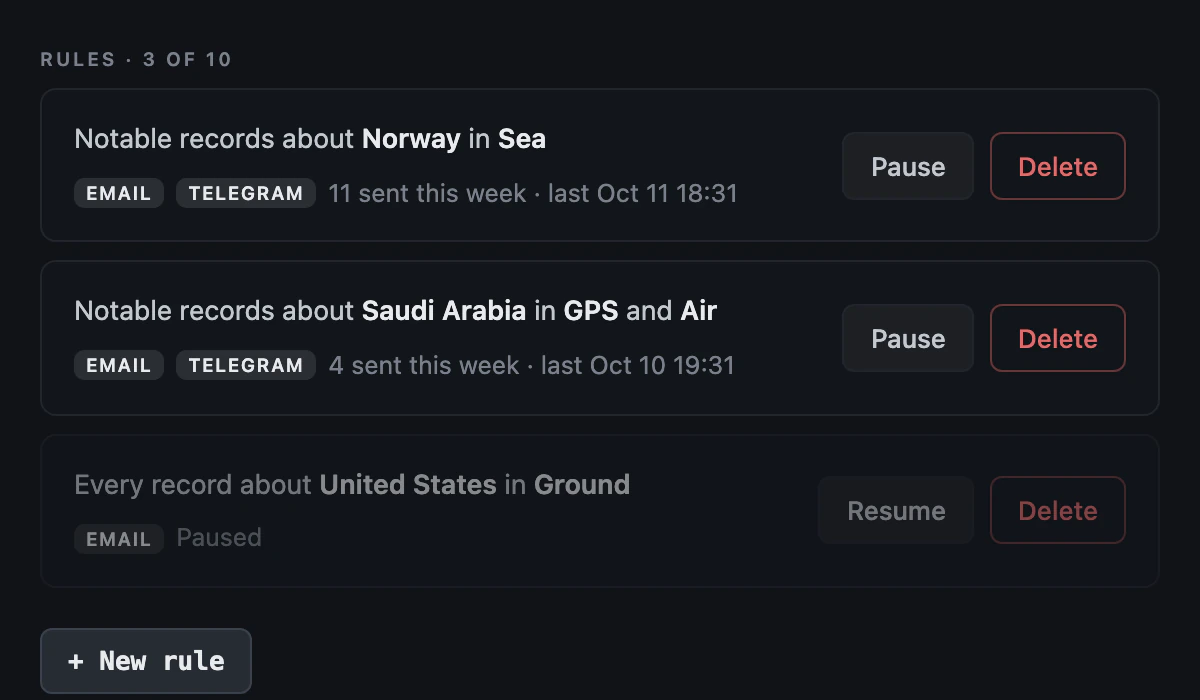
How to read it:
- An alert is sent when the record is written, not on a schedule.
Limits: A plan sends nothing until it has a rule; Telegram must be connected for a rule that sends there.
Related: GEO: The GEO list beside the chart · LIVE: Telegram: @FirmTapeBot and the channel
Build on it
The API, webhooks and MCP#
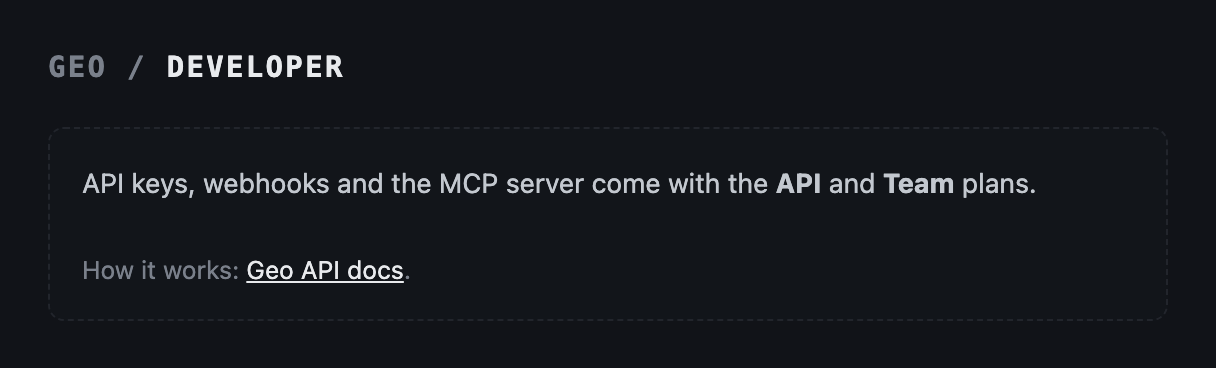
Why: the records as data, with every field, coordinates and source credit. Where: Account, Geo developer, on the API and Team plans; reference at /geo/docs. Plan: Geo API and Team plans. The open JSON is free.
- REST API: the records over HTTP with a key; /geo/docs.
- Webhooks: a signed POST when a record matches your rules; /geo/docs.
- MCP server: an AI assistant reads the records with the same key; /geo/docs.
Limits: Reading the pages and the open JSON needs no key.
Developer reference: /docs/developers/geo
Related: GEO: Geo alerts · REPLAY: MCP server
Add to GEO
Use it with other tools
| Tool | How it pairs |
|---|---|
| REPLAY: Market calendar and pulse | The calendar holds the scheduled releases; Geo holds what was published without a schedule. |
| REPLAY: The playback bar | Scrub a finished session and read that week's records on its week page. |
| LIVE: Telegram: @FirmTapeBot and the channel | Level alerts and Geo alerts can arrive in the same Telegram chat. |
| LIVE | Ask about the levels on screen while the GEO list shows what was published. |
Good to know
- A marker sits at the country's centre, not at the place of the event.
- Rows marked backfill came from a source's own history, not from live collection, and never count toward how fast a record was seen.
- A record is notable against its own source's normal for that country, not against the world.
- Geo plans are separate from LIVE, LAB and DATA; cancelling one never touches another.
If something looks wrong
| You see | Do this |
|---|---|
| The list is empty | Switch notable only off to see the routine rows; check the source count at the top. |
| A record I read elsewhere is missing | Geo reads its own list of public sources; /geo/sources shows which and how fresh each is. |
| No Geo alert arrives | A plan sends nothing until it has an alert rule; for Telegram, connect the chat on the same pane. |
Glossary
| Term | Meaning |
|---|---|
| record | One published item from a public source: its time, country, sector, text and link. |
| notable | A record that stands out against its source's own normal for that country. |
| routine | A record within its source's normal; hidden by default. |
| sector | The kind of record: government, air, GPS, sea, internet, ground, attention. |
| backfill | A row from a source's own history rather than live collection. |
Every reading here is a measurement of dealer positioning, never a forecast or a trade call.