Features / LIVE / Walls and levels
The strikes the dealer book leans on, drawn where price can meet them.
WALLS draws each book's call wall and put wall across the chart, LEVELS adds the strikes that keep standing out, and BANDS paints the interval each wall owns. Line width is the strike's share of the book, so a heavy wall looks heavy and a thin level looks thin.
LIVE for today's session; free on every finished session.
Open the terminalIn the LIVE guide
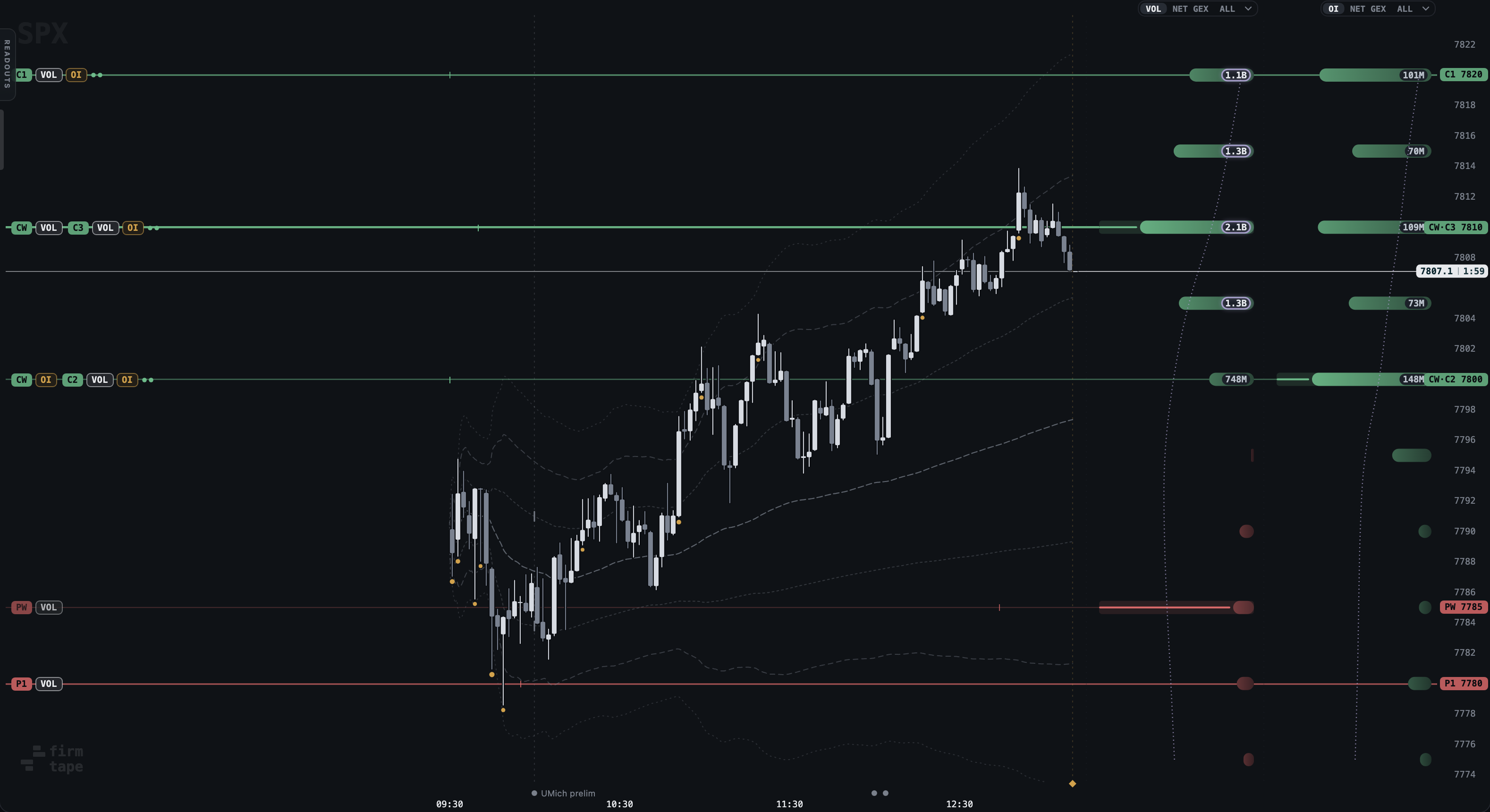
Why: the strikes the book leans on, drawn where price can meet them, each with its weight. Where: the chart bar switches WALLS, LEVELS and BANDS; which books draw is LAYERS > LEVELS OF.
How to use it
- Turn on WALLS to draw each book's call wall and put wall with its chip and price tag (CW 7810).
- Turn on LEVELS to add the levels of interest: strikes that keep standing out in the VOL and OI books, ranked C1, C2, P1, P2.
- In LAYERS > LEVELS OF, pick one, two or three books. Where two books agree on a price, their chips sit side by side on one line.
- Turn on BANDS to paint each wall over the strike interval it owns.
- Set the levels filter to hide levels holding less than a share of the strongest; 8 to 20% is the useful range, 0 shows everything.
How to read it
- Colour is the kind of level, never the book: green the major positive-gamma strike, red the major negative, amber the zero-gamma flip. The book is named on the chip.
- Width is weight: a fat line is a heavy wall, a thin one a level the book barely carries.
- Fade is distance: a level about forty points away draws at roughly a quarter strength.
- OI standouts at the open (yesterday's positions) are levels from the first minute; the rest appear once their strike has held up, and a short tick marks when.
- None of it says direction. Concentrated hedging holds price on a positive-gamma strike and speeds it away from a negative one.
Settings and controls
| Control | What it does |
|---|---|
| WALLS | Call wall and put wall of each selected book, with chips and price tags |
| LEVELS | Levels of interest from the VOL and OI books |
| BANDS | Half a strike step either side of each wall, opacity by share; never on the flip |
| LEVELS OF | Which books draw their levels (one to three) |
| levels filter | Minimum share of the strongest drawn level; a line below says how many were hidden |
What it measures
A wall is the major positive or negative gamma strike of a book; width is that strike's share of the near-money gamma in the window. A level of interest is a strike that has stood out for a while and stays for the day once it has held.
Limits
Whether price is drawn to strength has not been measured here; it is an open idea, not a claim. Walls, levels and session levels that meet on one price share a line and one price-scale plate (CW·C2·PDC 7620).
Related
Questions
- What is the difference between a wall and a level of interest?
- A wall is the single strike with the largest positive (call wall) or negative (put wall) gamma in a book at that minute. A level of interest is a strike that has stood out for a while in the VOL or OI book and stays on the chart for the day.
- Why does the colour not match the book?
- Colour is the kind of level: green for a positive-gamma strike, red for negative, amber for the flip. The book is named on the chip at the line's left end.
- Does price bounce off a wall?
- That is not a claim this chart makes. Concentrated hedging holds price on a positive-gamma strike and speeds it away from a negative one; whether price is drawn to a level has not been measured.
- Can I see all three books' walls at once?
- Yes. LAYERS > LEVELS OF draws one, two or three books; where they agree, their chips share one line.