Features / LAB / The LAB desk and the backtest
Describe an idea in plain words, and see whether it holds on every finished session.
LAB turns what you would say out loud into a rule with exact thresholds, runs it over the whole SPX archive, and judges it against the idea's own core condition, this year and over the last 40 sessions. The verdict is honest, including no edge, which is what most ideas get.
Developing is free; a backtest is one LAB credit.
Open LAB in the terminalIn the LAB guide
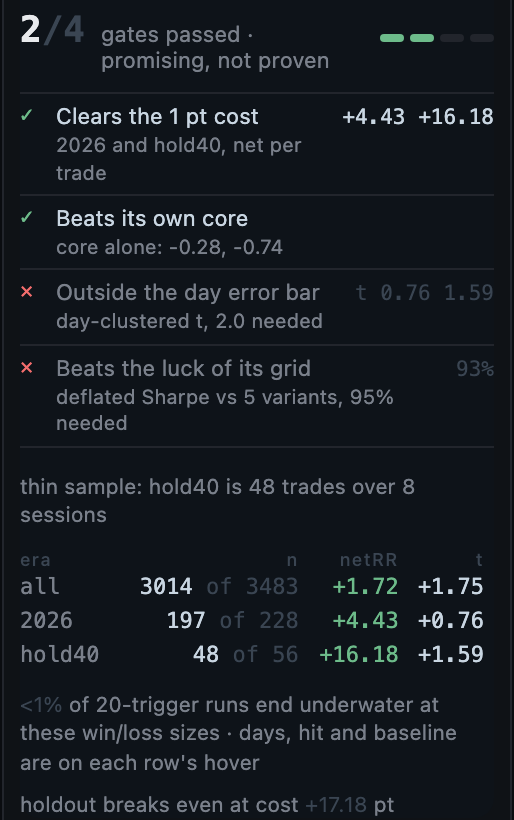
Why: a verdict on every finished session, against the idea's own core condition, out of sample. Where: LAB in the top bar; + NEW IDEA starts one, the box at the bottom sends it.
How to use it
- Press LAB in the top bar. The desk lists your ideas.
- Press + NEW IDEA and type the idea the way you would say it, for example a stretch off VWAP while the book is short gamma, with a 30-minute horizon.
- Read what LAB understood: the rule in words, with its thresholds, horizon and cost. If it cannot compile yet, it asks one concrete question instead of guessing.
- Press BACKTEST (one credit).
- Read the gates passed, then the era table under them.
How to read it
- 2/4 gates passed, promising, not proven means the rule has not cleared the bar; four of four means it owes a stricter test.
- A thin sample is named: 48 trades over 8 sessions is eight observations, not 48.
- A good number in one era and a poor one in another is a rule that did not hold.
Settings and controls
| Control | What it does |
|---|---|
| Clears the cost | Net per trade is positive after the cost, in 2026 and hold40 |
| Beats its own core | The full rule does better than its core condition alone |
| Outside the day error bar | The day-clustered t is at least 2.0 |
| Beats the luck of its grid | The deflated Sharpe against the variants tried is at least 95% |
| era table | n triggers, net per trade and t for all sessions, 2026 and hold40 |
What it measures
The rule runs over every archived session on a minute grid. For each trigger it measures the move over the horizon, after the cost, and compares the full rule with its core condition alone. The verdict is split out of sample: this year, and the last 40 sessions.
Limits
SPX only, inside one session, at a 5, 15 or 30 minute horizon. A tested idea can draw and alert on the chart with the same thresholds; that is a convenience, not a forecast.
Related
Questions
- What kind of idea can LAB test?
- An SPX intraday rule: conditions at one minute on the archive's columns (the clock, price and its distances, the levels of each book, flow, volatility, the calendar), and a move measured over the next 5, 15 or 30 minutes.
- Why compare with the core condition and not with doing nothing?
- Because a rule that trades in a rising market beats doing nothing for free. The question is whether your filter adds anything to the core it stands on.
- Why is the error bar measured across sessions?
- A setup that fires nine times in one afternoon was seen once. Counting triggers would make one good day look like a pattern.
- Can a rule pass and still be wrong?
- Yes. Passing all four gates means the rule owes a stricter test, such as a forward period it has never seen.